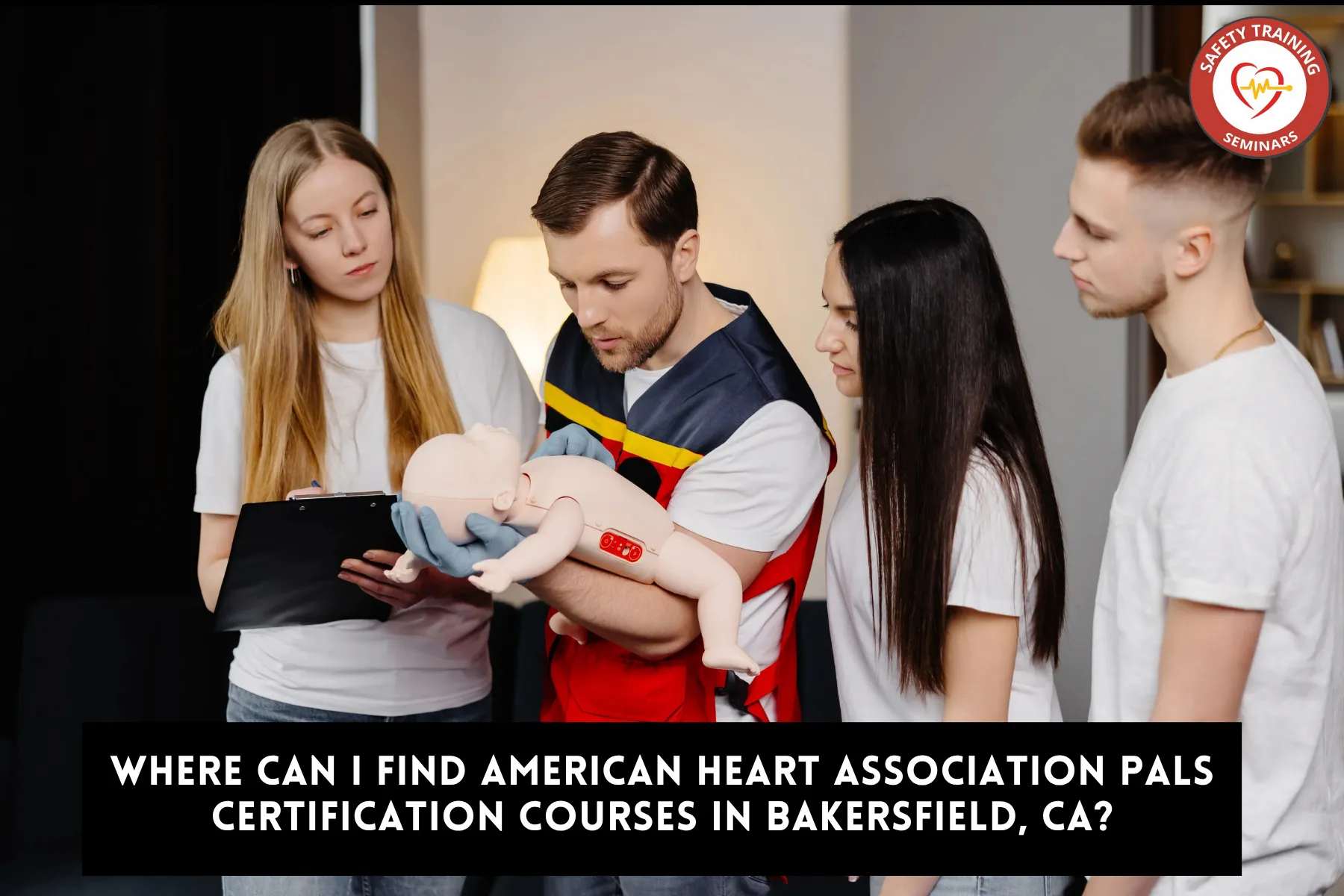
If you need an American Heart Association PALS class in Bakersfield, you can find one in three main ways: search the AHA’s official course finders, ask your employer’s education department, or book directly with a local AHA training provider. Safety Training Seminars runs a PALS certification course in Bakersfield out of its downtown-area training center. It offers the AHA’s Self-Guided Learning™ (HeartCode® Complete) format, which pairs online coursework with a hands-on skills session done on site. When you pass both parts, you get an AHA PALS Provider Course Completion eCard.
Below you’ll find how to locate legitimate options, how the course formats compare, and what to check before you register.
Why PALS Demand Is Concentrated in Bakersfield
Bakersfield is where much of Kern County’s serious pediatric care ends up. Memorial Hospital’s Lauren Small Children’s Center includes an eight-bed pediatric ICU that the hospital describes as the only PICU between Los Angeles and Madera, along with a 31-bed Level II NICU and a 35-bed pediatric acute care unit. Its Children’s Pavilion is also described as the only dedicated pediatric emergency department in that same stretch of the state.
The practical result is that critically ill children from Delano, Tehachapi, Taft, and other outlying communities are often transported into Bakersfield. Nurses, respiratory therapists, physicians, and paramedics across the city’s hospitals and EMS agencies may treat pediatric emergencies even if pediatrics isn’t their specialty.
That’s why a PALS credential appears in so many local job postings and credentialing checklists. Requirements vary by employer and department, so confirm with your manager or education coordinator which course and provider your facility accepts.
What the PALS Course Covers
Pediatric Advanced Life Support (PALS) is an AHA course for healthcare professionals who respond to emergencies in infants and children. It builds on BLS skills and focuses on recognizing deterioration early, before a child goes into cardiac arrest.
Core topics typically include:
- A systematic pediatric assessment approach
- Recognizing and managing respiratory distress and respiratory failure
- Identifying and treating different types of shock
- Pediatric rhythm recognition, including bradycardia and tachycardia
- Cardiac arrest management, defibrillation, and synchronized cardioversion
- Team roles and communication during resuscitation
- Post-cardiac arrest care
The AHA updates its resuscitation guidelines periodically. A current course should reflect the most recent science, so ask any provider which guideline edition its materials follow.
Three Ways to Find Legitimate AHA PALS Classes
1. Use the AHA’s Official Search Tools
The American Heart Association lists instructor-led and blended courses through its course finder at cpr.heart.org. For the newer Self-Guided Learning format, the AHA directs learners to CPR Finder™ (cprfinder.com). You enter a ZIP code there to locate CPR Verification Station™ learning centers nearby. Searching with a Bakersfield ZIP such as 93301 is a fast way to see which locations are active.
2. Check With Your Employer or School
Many hospitals offer internal PALS classes or approve specific outside providers. Nursing and allied health students should ask their program, since clinical placements may set their own requirements and deadlines.
3. Contact a Local AHA Training Provider
Independent training sites often have more schedule options than internal hospital classes. This matters if you work nights, rotate shifts, or need a card quickly for a new job.
PALS Course Formats Compared
The AHA delivers PALS in several ways, and every format results in the same AHA Course Completion eCard when all requirements are met.
| Format | How It Works | Best For |
| Instructor-led | Classroom learning and skills practice with an AHA instructor | Learners who want live teaching and group megacode practice |
| Blended learning (HeartCode®) | Online coursework followed by an in-person skills session with an instructor | Busy providers who still want instructor feedback |
| Self-Guided Learning™ (HeartCode® Complete) | Online coursework followed by a self-guided skills session at a CPR Verification Station™ | Shift workers and renewing providers who want maximum scheduling control |
The AHA and Laerdal Medical announced the nationwide rollout of Self-Guided Learning in March 2026. In this format, a CPR Verification Station uses simulation technology to give real-time, objective feedback on your skills without an instructor present. The AHA describes it as suitable for both initial and renewal learners.
If your employer requires an instructor-led class, confirm that before booking a self-guided option.
PALS Training at Safety Training Seminars in Bakersfield
Safety Training Seminars operates its Bakersfield CPR training center at 2116 24th Street, Suite 2, Bakersfield, CA 93301, on 24th Street near downtown. The location is listed as offering access from Highway 99 and on-site parking, which makes it workable for providers coming in from Oildale, Rosedale, Shafter, or Lamont.
Based on the company’s current course information, here is what to expect:
- Format: Self-Guided Learning™ PALS (HeartCode® Complete), with the online portion completed on your own device
- Time commitment: About 2–3 hours online, followed by a skills session of roughly 30 minutes at the Bakersfield CPR Verification Station™
- Card: An AHA PALS Provider Course Completion eCard issued the same day after successful completion
- Hours: Listed as Monday through Sunday, 8 a.m. to 10 p.m.
- Price: Listed at $290 at the time of writing, with a price-match policy and occasional promo codes
Prices, promotions, and availability can change. Check the PALS certification course in Bakersfield page for current details before you register.
The center also handles BLS, ACLS, and NRP training. That’s useful if your credentialing packet requires more than one card, because you can schedule related skills sessions at the same location.
How to Prepare for Your PALS Class
PALS is not a course most people can pass on clinical instinct alone. A little preparation makes the online modules and skills session go faster.
- Keep BLS sharp. High-quality infant and child CPR is the foundation of every PALS scenario.
- Review pediatric rhythms. Be comfortable identifying sinus tachycardia, SVT, bradycardia, VF, pulseless VT, asystole, and PEA.
- Know common drug doses conceptually. Understand when epinephrine, adenosine, and amiodarone are indicated.
- Study the algorithms. The cardiac arrest, bradycardia, and tachycardia algorithms come up repeatedly.
- Block uninterrupted time. The adaptive online coursework works best when you can focus without pages or alarms.
Initial PALS vs. PALS Renewal
An AHA PALS Course Completion eCard is generally valid for two years. Renewal students typically move through familiar material more quickly, especially in adaptive online formats that focus on knowledge gaps.
If your card has already expired, many employers will accept a new course completion, but some have their own rules about lapsed credentials. Ask your facility before your expiration date so you aren’t pulled from the schedule.
Frequently Asked Questions
Is online-only PALS accepted in Bakersfield?
No, an online-only PALS course will not produce a valid AHA card. Every AHA PALS format requires a hands-on skills component, either with an instructor or at a CPR Verification Station.
Who usually needs PALS certification?
PALS is most often requested for emergency department nurses, pediatric and PICU nurses, respiratory therapists, paramedics, emergency physicians, and urgent care staff. Some employers also require it for nurse anesthetists, flight crews, and certain pediatric clinic roles. Confirm the requirement with your employer.
How quickly can I get my PALS eCard?
At Safety Training Seminars in Bakersfield, the eCard is issued the same day you successfully complete both the online coursework and the skills session. Plan your online portion early if you face a hiring or credentialing deadline.
Is PALS the same as NRP?
No. PALS covers infants and children, while the Neonatal Resuscitation Program (NRP) from the American Academy of Pediatrics focuses on newborns at delivery. Labor and delivery and NICU staff are often asked for NRP, sometimes in addition to PALS.
Do I need a current BLS card before taking PALS?
The AHA expects PALS students to have strong BLS skills, and many employers require a current BLS card alongside PALS. Check with your provider and employer about whether proof of BLS is needed.
Finding the Right PALS Class in Bakersfield
Finding an American Heart Association PALS class in Bakersfield comes down to choosing a legitimate AHA option that fits both your schedule and your employer’s rules. Use the AHA’s course finders to check what’s available, confirm which formats your facility accepts, and pick a provider that issues an official AHA Course Completion eCard.
For providers who want flexible scheduling, the Self-Guided Learning option at Safety Training Seminars lets you complete coursework on your own time and finish the skills session at the 24th Street center. You can explore the full lineup of AHA CPR, BLS, ACLS, and PALS courses in Bakersfield to plan every credential you need this cycle.